(Editor’s Note: I drafted this article back in 2021, when I was playtesting the deck during COVID. I realized I never published the article, so I’ve made some adjustments and released it for you all today. Enjoy!)
In previous articles, I’ve sung the praises of the Blood Angels: a Space Marine faction with a glorious First Wave of 2.
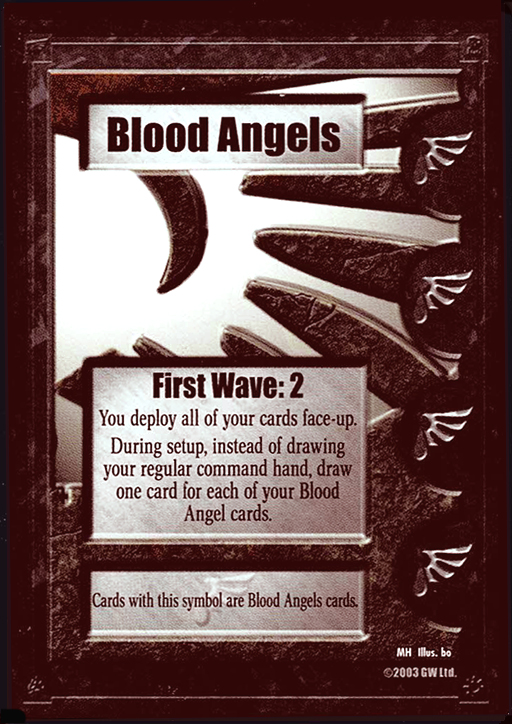
It is obvious that the increased First Wave is a massive advantage for Space Marines, who come with superior unit stats compared to most other armies. But what other advantages and disadvantages are we working with? Let’s take a look.
Analyzing the Fleet Card
You deploy all of your cards face-up.
First, Blood Angels must deploy all of their cards face-up. This effect removes most elements of bluffing or surprise from your deployment strategy. But, is it really a downside?
To start, you can mitigate this effect to a certain extent by saving your lynchpin deployments (Such as characters, mass-kill units, and armor-boosters) until the last card or two of your deployment hand, in order to give your opponent as little time as possible to react.
Next, to understand why this effect may not be such a downside, we have to take a look at the second line of the fleet card.
During setup, instead of drawing your regular command hand, you draw one card for each of your Blood Angels cards.
This fleet ability rewards you for: a) filling your deck with Blood Angels, and b) stacking Blood Angels cards at a minimal number of sectors. Spreading out your forces commonly means a 1 or 2-card command hand, which kinda sucks.
With an 8-card deployment divided amongst two sectors, you will draw an average of 4 command cards per sector – the usual for most armies. However, by keeping your forces alive for subsequent battles you can potentially snowball into much larger command hands during later turns.
Provided you maintain a decent number of Blood Angels on the table, and that you concentrate subsequent deployments on those same sectors, as the game progresses you will accrue increasingly greater numerical advantages – especially if the game comes down to a fifth sector, where you can amass an incredible command hand.
With the second fleet ability in mind, let’s return to the first. If you plan on stacking Blood Angels at one or two sectors, it doesn’t necessarily matter as much if your opponent knows where you are going, since you’re not splitting up your deployments in an attempt to bluff them out.
Your deployment strategy will rely less on bluffing and more on committing to high-value sectors. If your opponent chooses to spread out across 3 or 4 sectors, you can pile up on the highest-value sectors and dare them to challenge you. With a First Wave of 2 and an increasingly massive grip of command cards the bigger your army grows, you are significantly favored in larger battles.
The Deck List


Deck Choices
The purpose of the deck is to overwhelm the opponent with tough-as-nails assault units that can charge faster than normal assault-themed decks. Troop capacity units and reactive charging can set up efficient assaults, and large command hands will translate into flag preservation by fueling repeatable armor-boosting cards such as Command Rhino and Apothecary Singa.
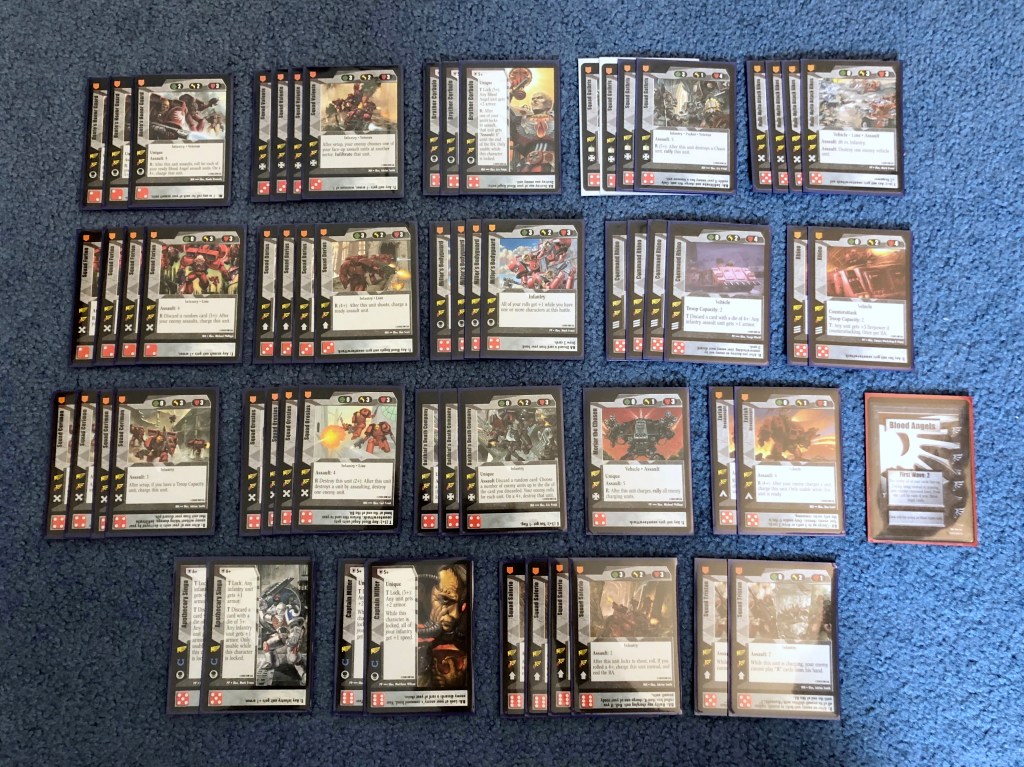
By the numbers:
- 45 flag units
- 7 characters
- 42 cards with a die of 4+
- 54 Blood Angel cards
- 6 troop capacity units
- 6 repeatable armor-boosters
- 35 assault units (24 Blood Angel infantry assault units)
- 22 3-firepower units
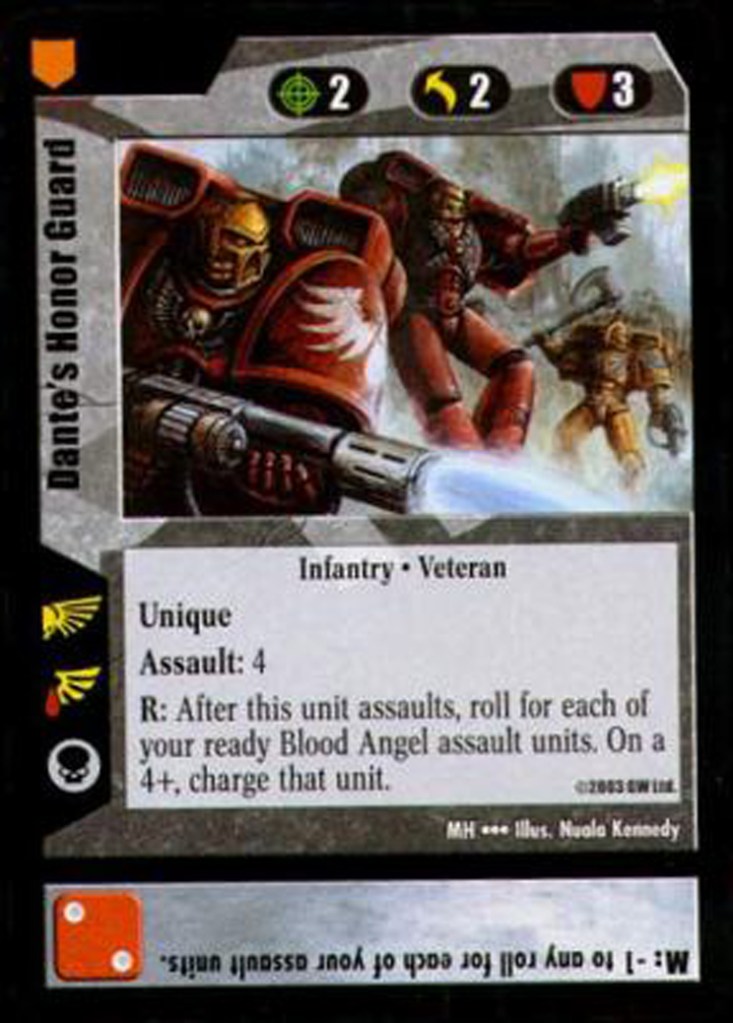
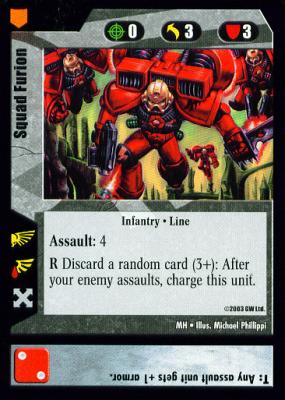
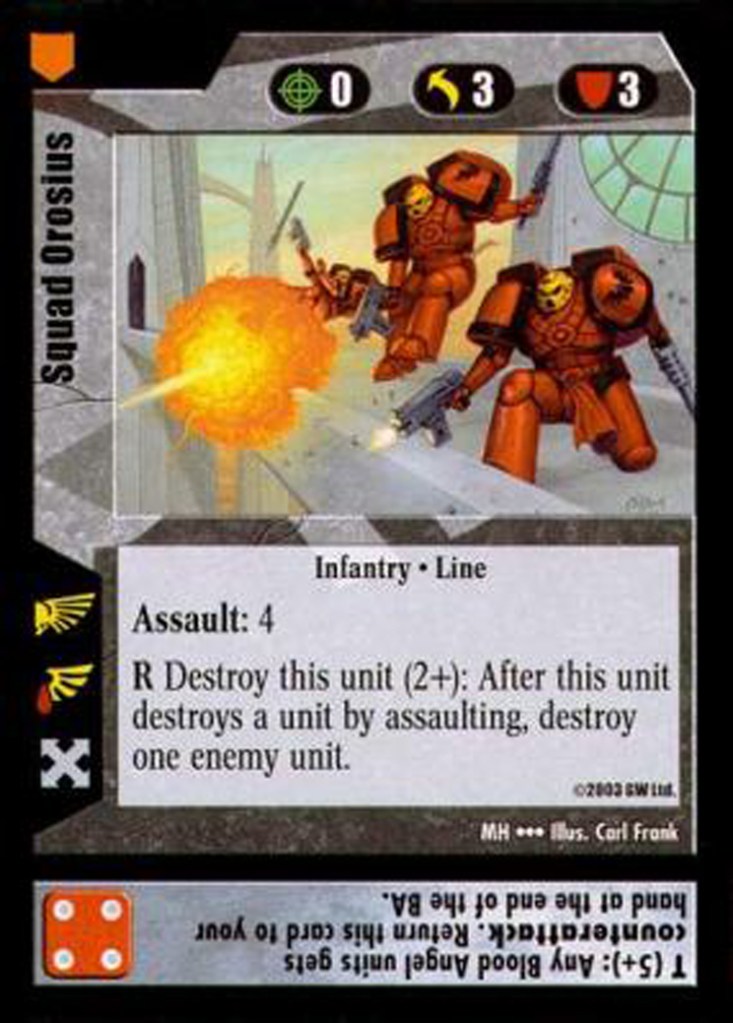
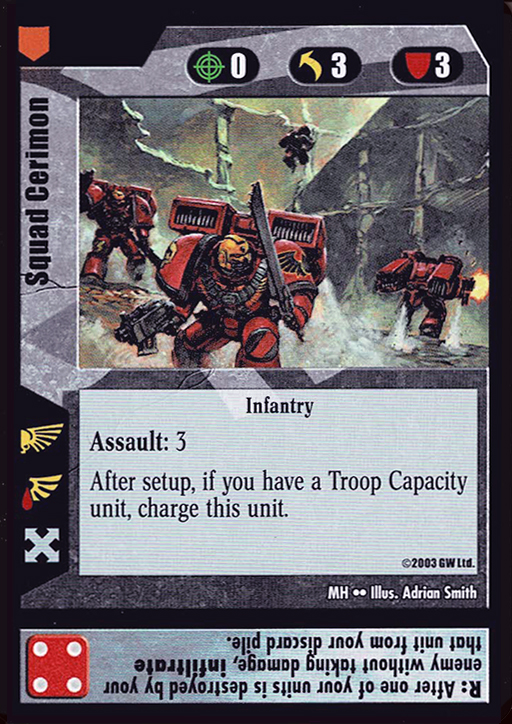
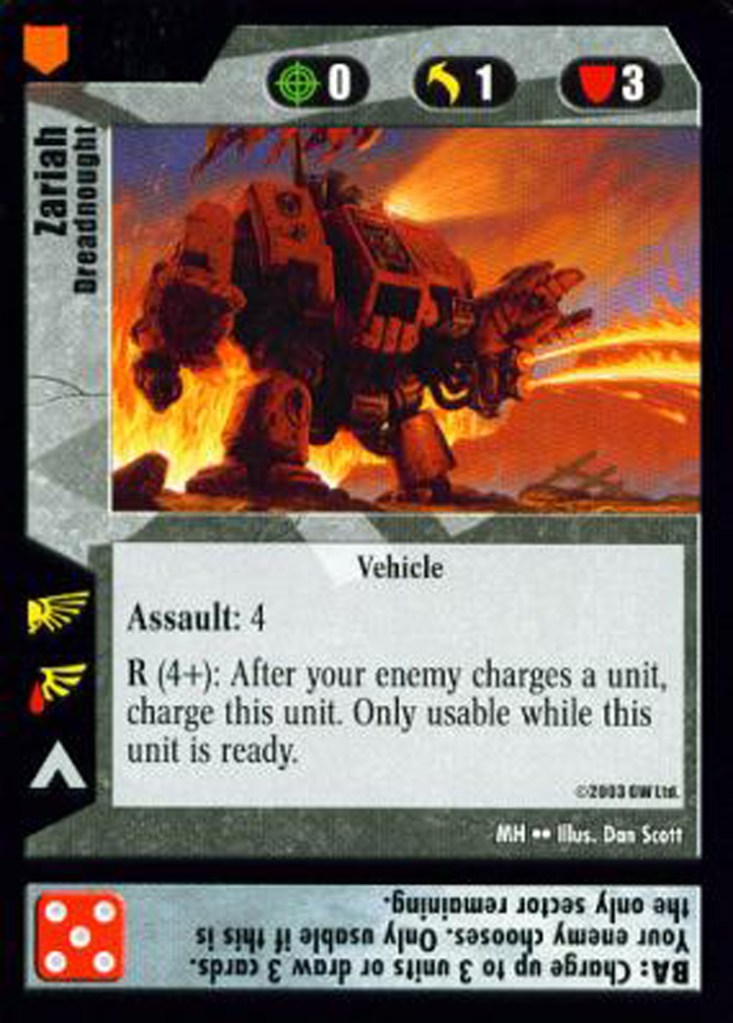
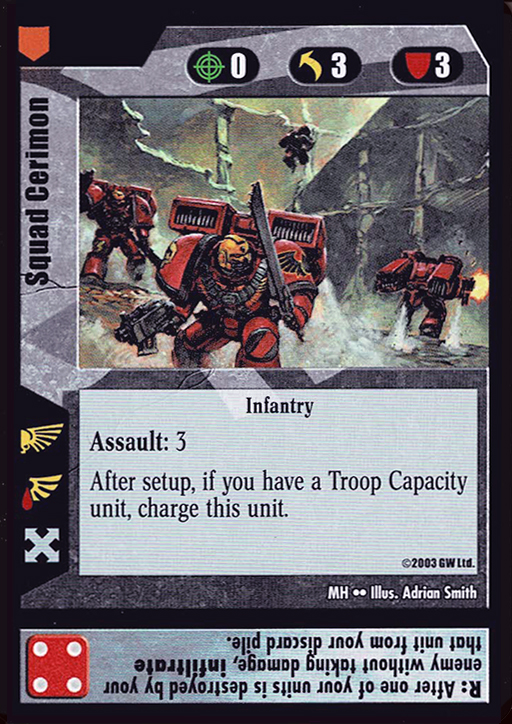
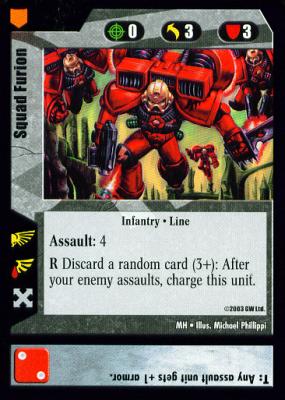
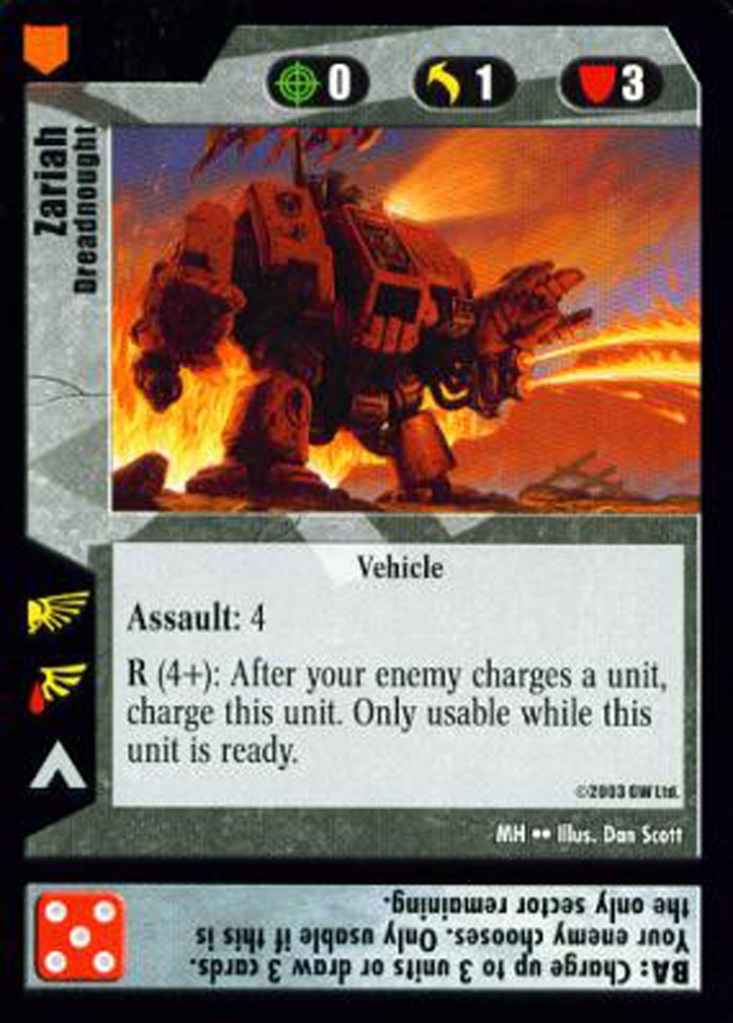
The most obvious theme of Blood Angels is that they come with an impressive array of assault units. Some of their most effective units are reactive and tempo-based, such as Squad Furion, Squad Cerimon, and Zariah – Dreadnought:
When building the deck, I faced one large decision: Balthial’s Death Company or Vindicator?


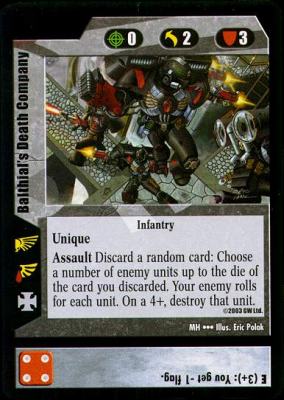
Balthial’s Death Company is the Blood Angels counterpart to the vanilla Vindicator: both operate very similarly, but come with their own pros and cons.
Vindicator:
- More resilient with 4 armor
- Targets 3 units no matter what
- Draws you cards for each unit destroyed
- Infinitely better command line
Balthial’s DC:
- Can target up to 6 units
- Armor can be boosted far more easily
- Can charge via troop capacity units
- Higher die roll
I have gone back and forth on each, but I am currently deciding on Balthial’s Death Company for the flavor points and Blood Angels synergy.
To complement my infantry assault units, I’m playing two Blood Angels transports: Rhino and Command Rhino.

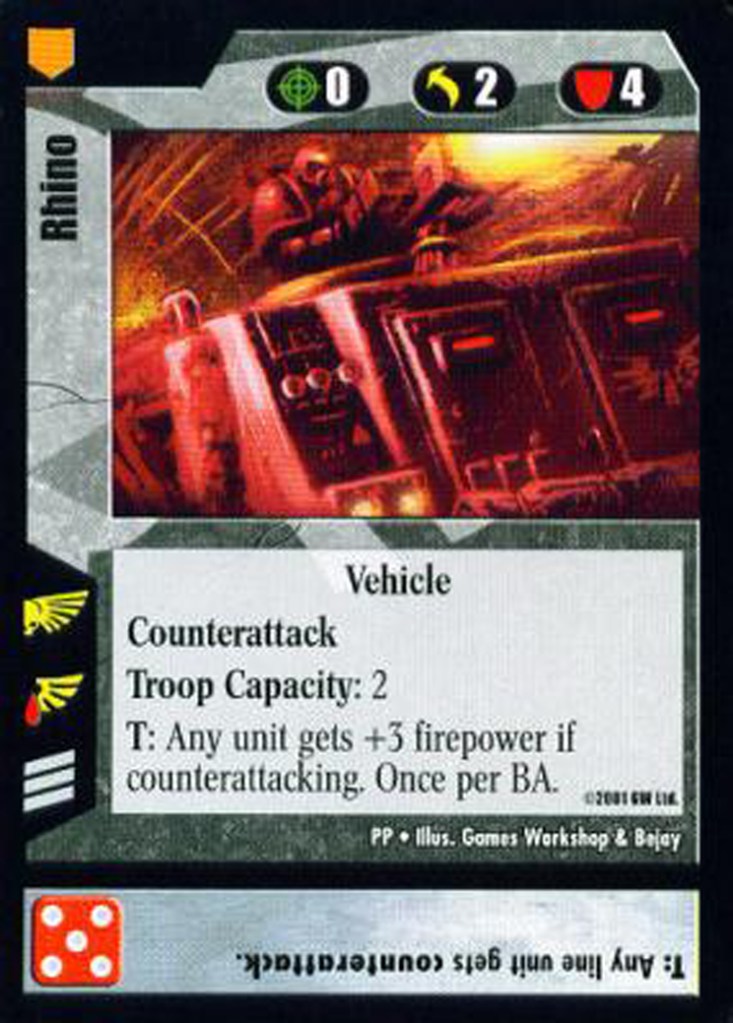
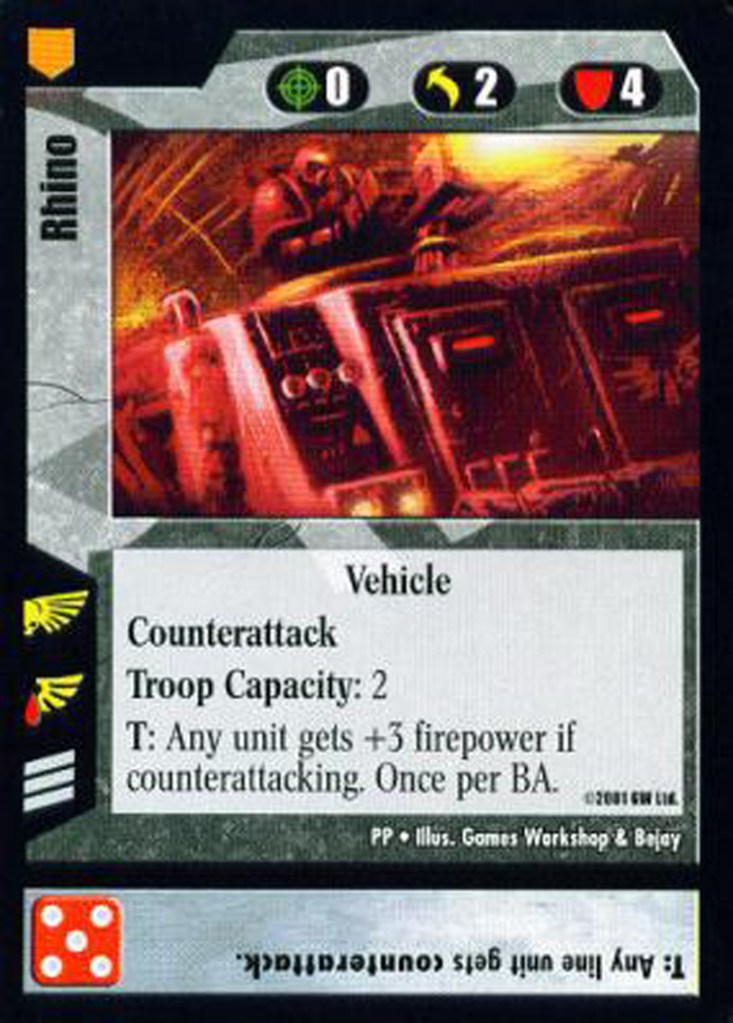
Rhino is a classic workhorse card that can boost your counterattacking capabilities – which, while it isn’t a major theme, can come in handy. The Command Rhino functions as both an armor boosting role player and a discard outlet for cards you’d rather not have in your hand – such as Balthial’s Death Company, or low-die cards to set up a devastating Balthial’s DC assault.
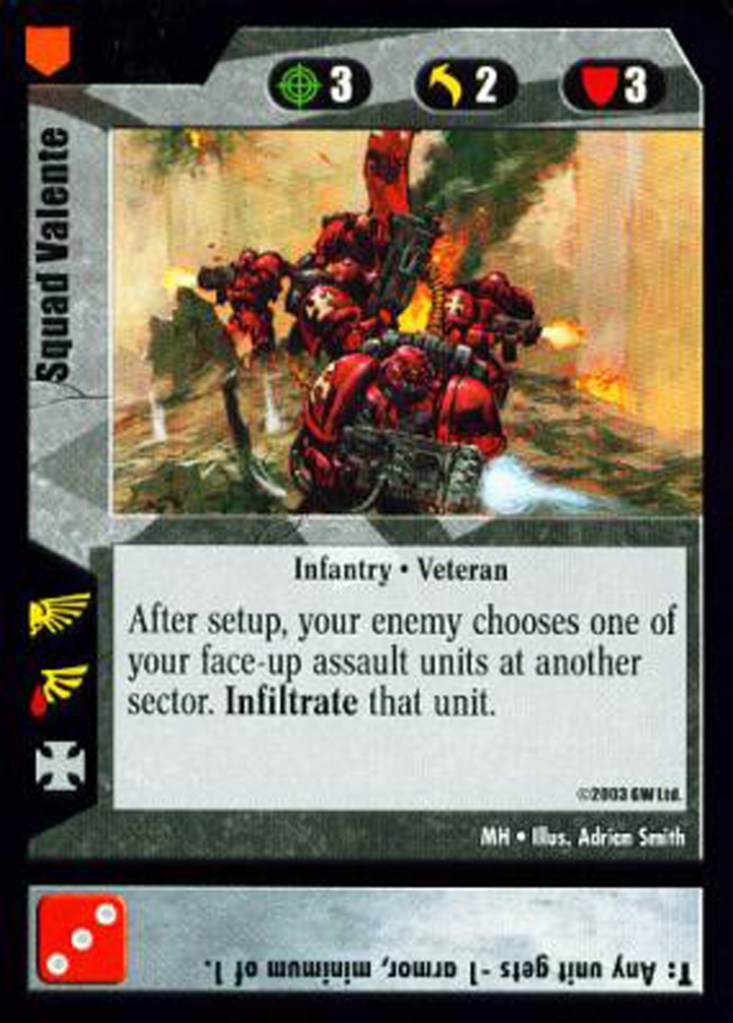
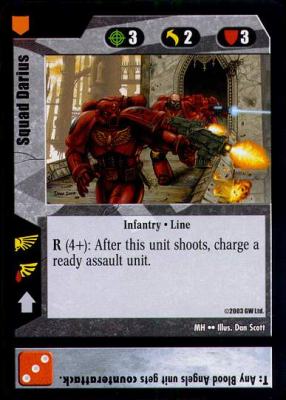
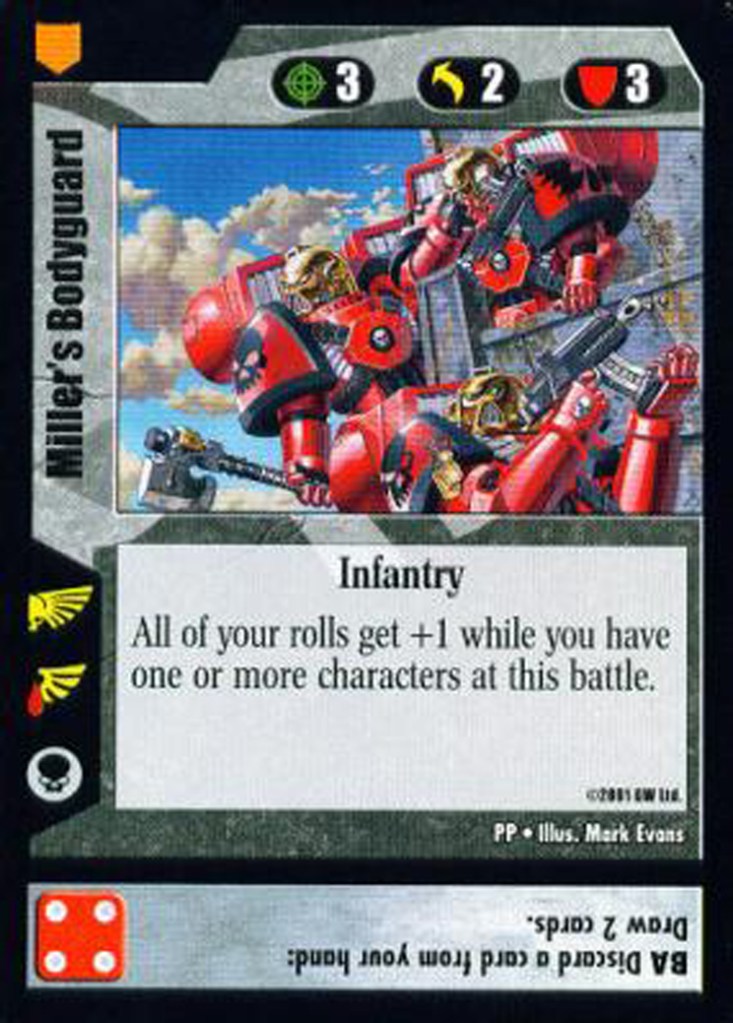
Between our reactive assault units and our troop transports, we will have no problem gaining tempo on our charges. Backing up our assault units will be a core of shooting units, such as Squad Darius, Squad Valente, and Miller’s Bodyguard:
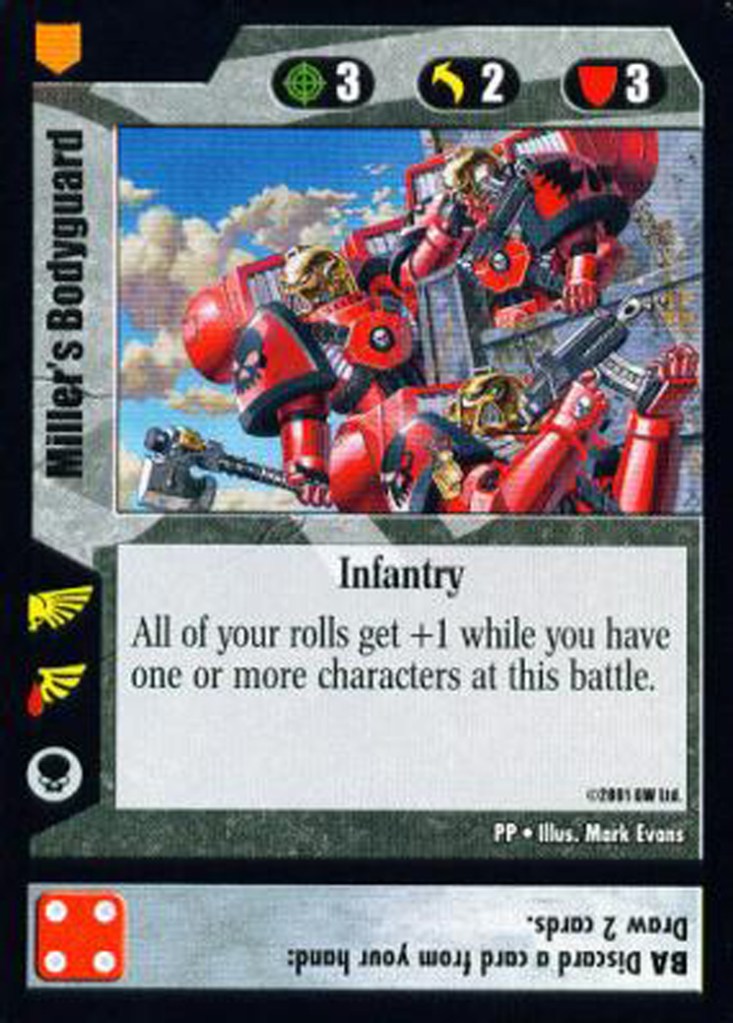
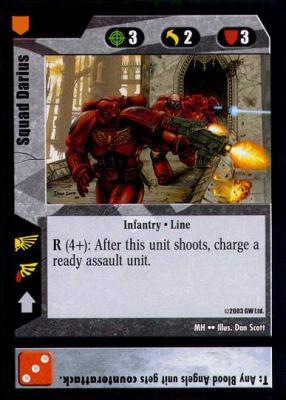

Squad Darius offers even more tempo for our assault units. Squad Valente allows us to reposition isolated Blood Angels units at other sectors to sectors you intend on stacking in the future, as 1 or 2 Blood Angels at a sector are not ideal due to the resulting puny command hands. Finally, Miller’s Bodyguard is a Space Marines staple that gains even more value as a Blood Angel (and is a good reason to keep playing a decent number of characters.)
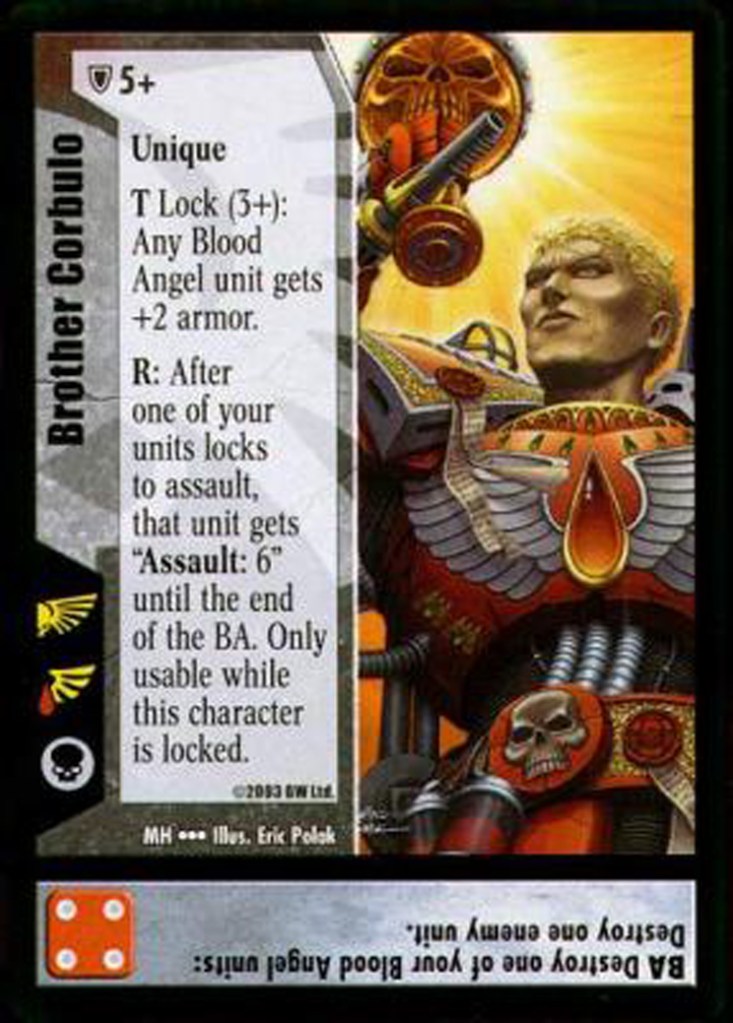
For the character suite, I landed on the following:
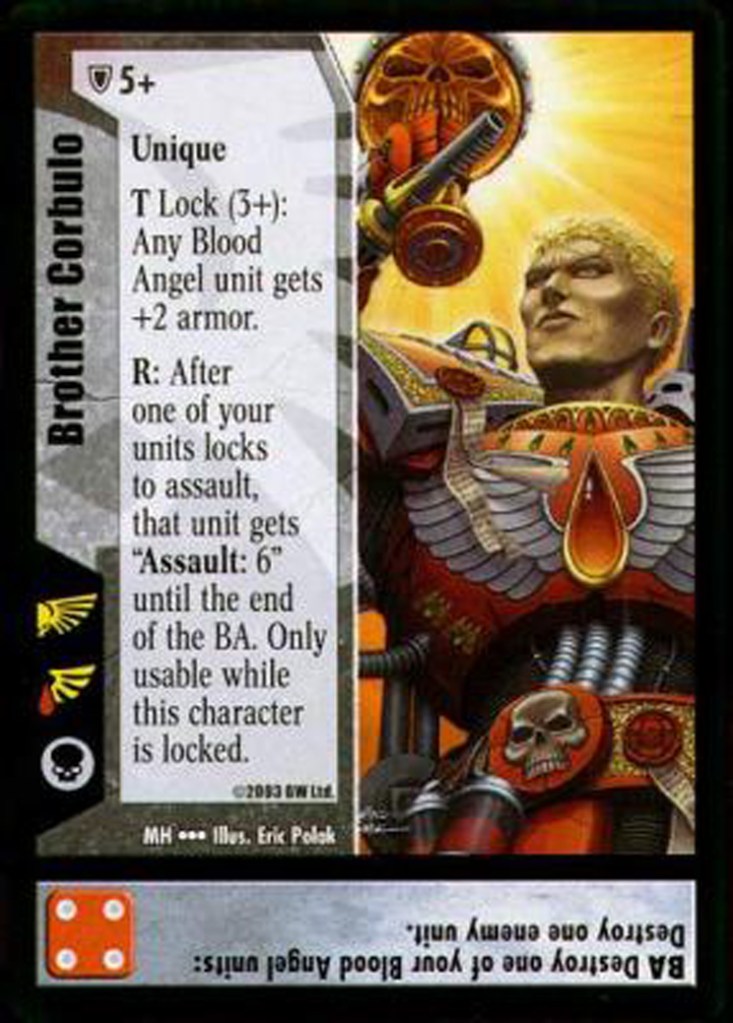
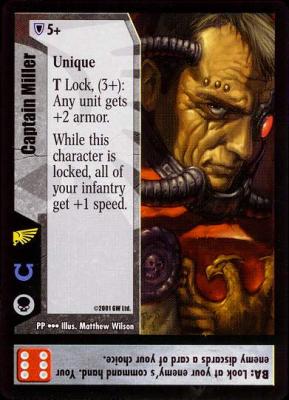
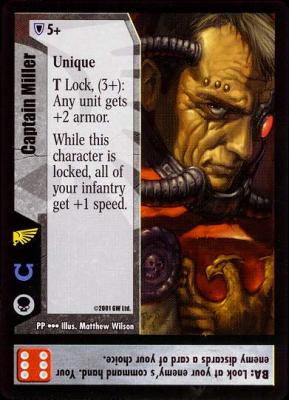
All of these characters help keep your Marines alive, and come with valuable bonuses to boot. Brother Corbulo’s command line is fantastic at removing high-priority threats early in a battle, or denying your opponent a flag when it really counts.
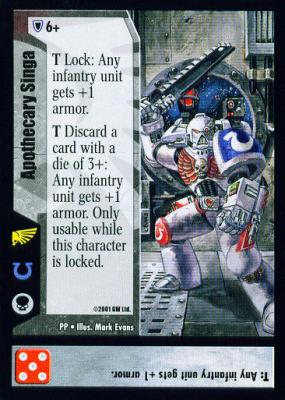
Armor boosting is a key theme of Space Marine decks, and we plan on keeping that theme alive with our characters, as well as with our Command Rhinos. Apothecary Singa is a Marine all-star and quite possibly one of the best cards in the faction, although Squad Faustus can play a similar role.
Other support units worth mentioning:
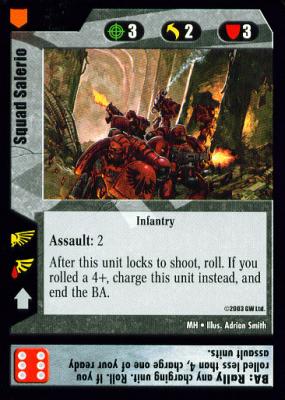
Squad Salerio – Sometimes you need cards that give you benefits (3 firepower, 6 die roll) despite their downsides. Squad Salerio is one such unit, but consider that its charge ability is not always a downside. Despite offering lower damage, assaulting cannot be blocked, and can be boosted by Brother Corbulo.
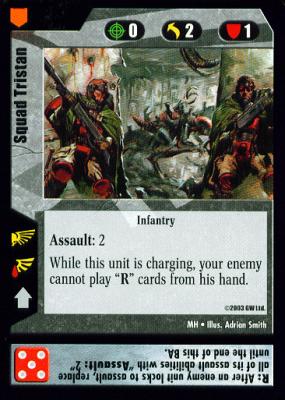
Squad Tristan – Despite being the frailest unit in the deck, Tristan offers the ability to shut down reactions from your opponent’s hand. Its CL can also shut down mass-kill assault units, giving you some insurance against the Avatars and Greater Daemons of the 40K CCG.
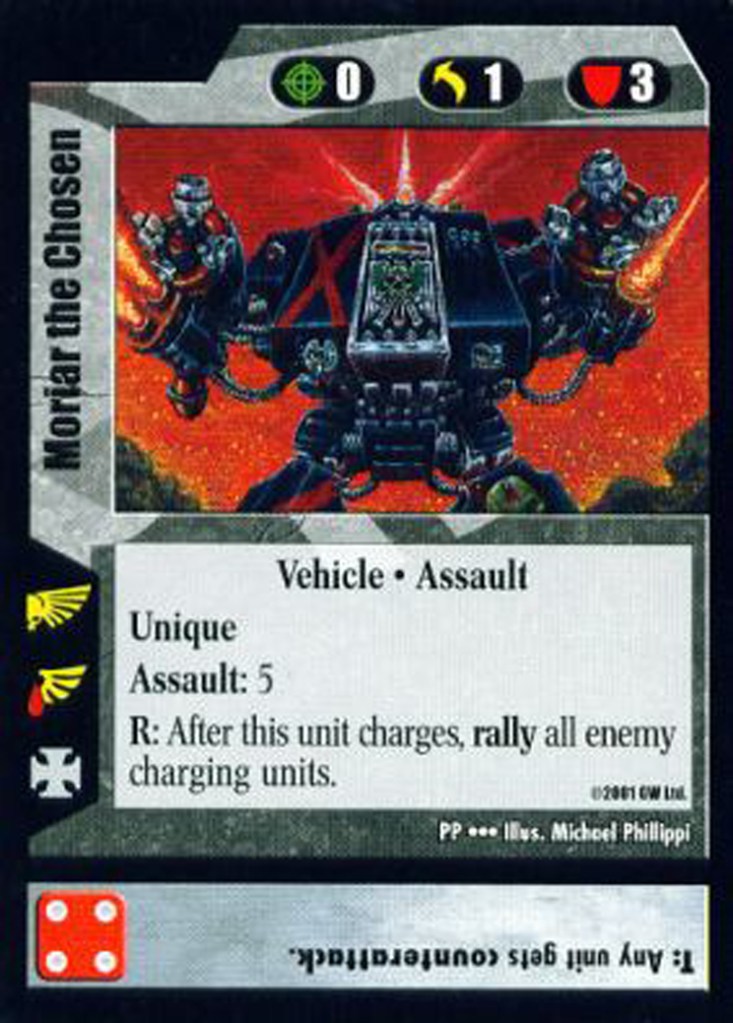
Moriar the Chosen – My fun-of 1-of! 3 armor is a bit fragile, but Moriar is otherwise a decent assault unit that can stifle opposing assault units.
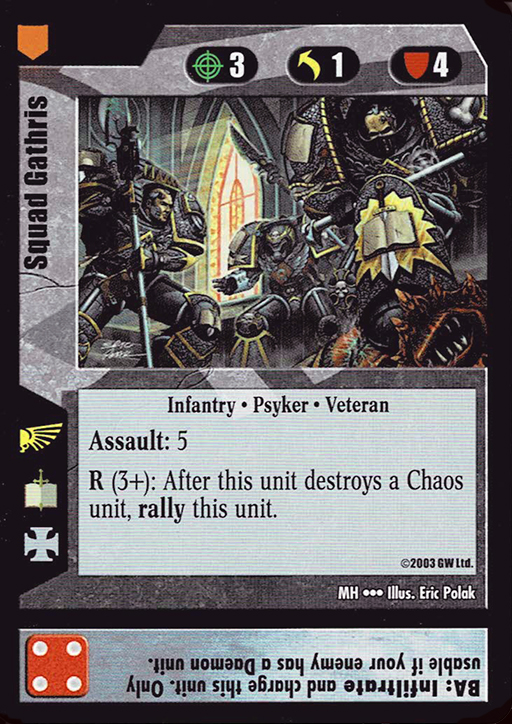
Squad Gathris – I hate Chaos. That is all.
On Blood Angel Assaults
As a footnote, Blood Angels don’t have a lot of options for high-speed shooting. Firepower boosting is rare for Space Marines, and most Blood Angel units with speed greater than 2 are 0-firepower assault units. They have only one bike unit, and zero Land Speeder units.
This leads me to believe that assaulting is Blood Angels’ fastest method of removing high-priority threats, which generally runs counter to other armies’ strategies. Whereas other armies snipe off units with their high-speed specialized shooters, then mop up with assault units, Blood Angels do the opposite since most of their shooters are speed 2 or less.
However, since they have so many options to gain tempo when they charge, combined with their units’ toughness, Blood Angels have the speed and the resilience to weather shooting attacks before assaulting key opposing units.
That’s my Blood Angels deck in a nutshell! What do you think? Are there any Blood Angel cards I should try playing? Let me know in the comments.
 Pandora Prime Recon
6 replies on “Deck Tech: Blood Angels”
Hi there!
Here’s my BA deck. If my memory serves me correctly, she is quite strong, but predictable, obviously.
Brother Corbulo 4
Captain Miller 4
Balthial’s Death Company 3
Death Company 2
Squad Severin 4
Blood Angels Terminators 4
Dante’s Honor Guard 3
Squad Danton 2
Squad Orosius 4
Squad Furion 2
Squad Cerimon 4
Squad Duranthor 4
Miller’s Bodyguard 4
Sgt Ragnar’s Squad 3
Squad Tristan 3
Command Rhino 3
Thunderhawk Gunship 3
Abandoned Quarry 4
https://disk.yandex.ru/i/MKIDEw364HYYvA
LikeLike
Nice list! How did you like Squad Tristan?
LikeLike
IMHO, the Squad Tristan is not the strongest (on the field), with the situational ability to deny enemy reactions. But the good dice, and especially the command line, makes it a great card. “R” from hand can ruin many powerful assault units (from an Avatar or an Angron to Great Demons or a SM Vindicators). Any way, it seems to me that Squad Tristan is absolutely necessary for the deck of Blood Angels.
LikeLiked by 1 person
Me alegra que continúes subiendo contenido al Blog. Haces un gran trabajo. Y gracias por los pedazo de análisis que haces. Posiblemente solo somos dos los jugadores de mi ciudad :)…(Burgos España) pero se agradece a alguien hablando de este gran juego. Muchas suerte.
LikeLike
¡Gracias por leer!
LikeLike
I’d love it if you did more Deck Techs, they are all really useful and interesting to read
LikeLike